
Neglect
Child neglect is the most common form of child maltreatment in England and features in over 50% of safeguarding reviews. It is often under-recognised, inconsistently defined, and responded to too late, despite its long-term impact on children’s health, development, safety, and wellbeing. This page provides key information and resources to support early recognition and effective action.
Key information
Safeguarding reviews show that neglect is common, complex and can be missed. Understanding these recurring issues can help improve practice:
-
Child neglect can affect babies, children and adolescents but can be missed, especially when concerns relate to poverty, parental challenges, or chronic low‑level issues that build gradually
-
Delays in identification are frequently linked to unclear definitions, inconsistent thresholds, and reliance on terms such as ‘persistence’ and ‘serious impairment’.
-
Many responses to neglect are episodic and fragmented, resulting in missed opportunities to understand cumulative harm
-
Children’s voices and lived experiences are not consistently captured, and home conditions are often not seen or explored in enough depth
-
Early help and coordinated support are frequently hindered by consent barriers, capacity pressures, and inconsistent multi‑agency working
-
A more proactive, child‑centred and trauma‑informed approach is needed – one that names neglect clearly and responds early
-
Strong practice requires shared chronologies, structured tools, multi‑agency information sharing, and a clear focus on the child’s daily life, safety, and wellbeing
Video explainers
National and local reviews
Thematic analysis and supporting documents
The Panel’s thematic review, “Why did it take so long to respond?”, explores how neglect is defined, identified and addressed in England, and why concerns are sometimes recognised too late. It draws on extensive stakeholder engagement, an accompanying literature review, and a qualitative analysis of 100 rapid reviews and 34 related local child safeguarding practice reviews (LCSPRs).
View the accompanying Literature review, Abridged version, Neglect across the childhood spectrum, and Typologies of neglect.
Local reviews
The examples below highlight useful learning for those working with children who are experiencing neglect.
Infographics and statistics
Figures are drawn from analysis of rapid reviews in 2024–2025, including more detailed analysis of cases where neglect was identified.
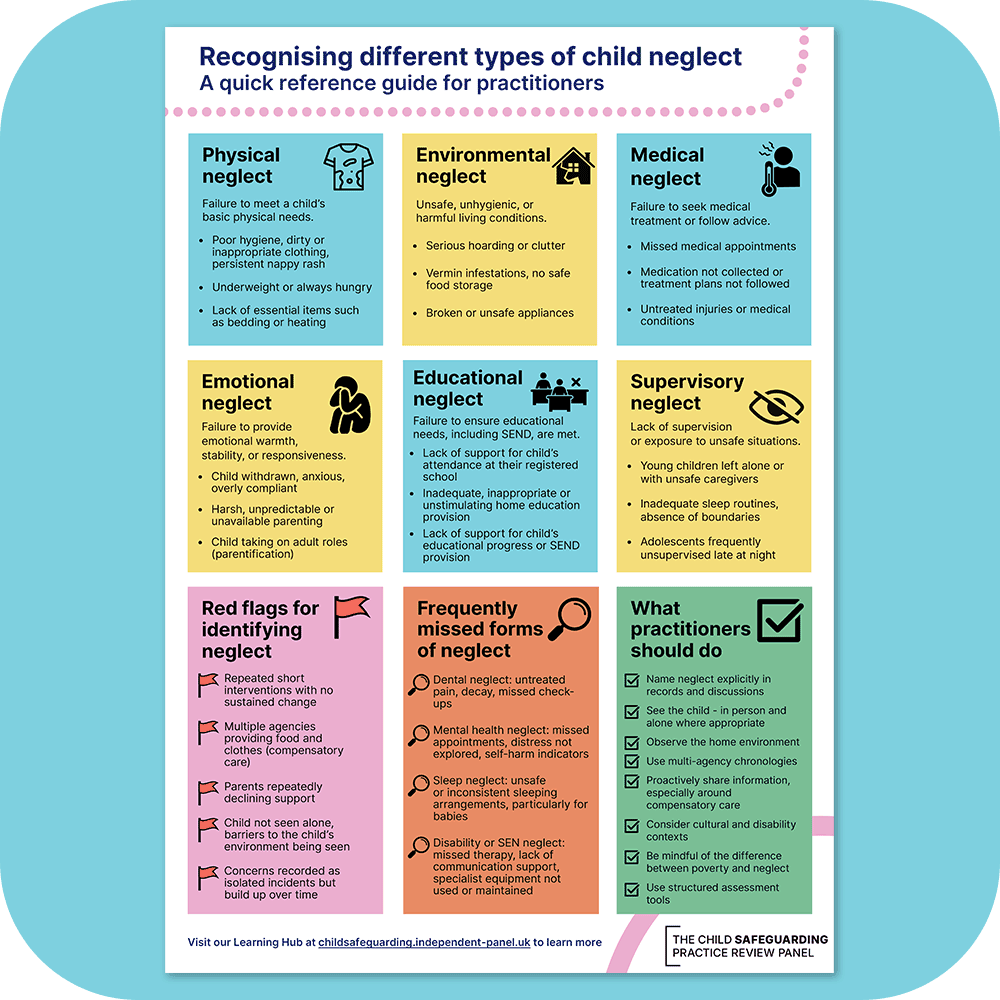
Download our poster about recognising types of neglect and share it with your teams.
Briefing papers and learning
Briefing papers
Short guides to support team reflection and local learning:
This practical guide can support teams to review current practice, identify gaps in the use of neglect tools and plan training or system changes that promote consistency.
This resource should be used as a practical guide and reflective tool to strengthen responses to child neglect, ensuring that the voice of the child is central in assessments and interventions.
This resource aims to help professionals move beyond focusing on isolated incidents and towards recognising patterns of cumulative harm caused by neglect.
Learning points
- Understand the child’s day to day experience, not just presenting issues
- Observe parent–child interaction
- Ensure children are seen alone when appropriate
- Small concerns add up—don’t wait for a crisis
- Use shared chronologies and multi-agency information
- Describe what you see and name ‘neglect’ where appropriate
- Early help is essential—don’t wait for statutory thresholds
- Escalate where consent is withheld but concerns persist
- Reflect on poverty, trauma, disability, culture, racism and bias, without allowing these to mask risk
- Share concerns, including compensatory care (food parcels, hygiene supplies, uniform support)
- Use structured tools consistently to support evidence-based decisions
What you need to know in your role
All practitioners, including those in the voluntary and community sector, have a legal duty to safeguard and promote the welfare of children. In line with the Children Act 1989 and Working Together to Safeguard Children, safeguarding is everyone’s responsibility. While we have drawn out key learning for specific agencies, it applies to all practitioners across settings and professions.
- Name neglect clearly and analyse cumulative harm, using chronologies and multiagency information to understand long-term patterns
- Explore parenting capacity, parent-child interaction, routines, boundaries and emotional availability — not just presenting issues
- Observe the home environment, checking each child’s bedroom, living conditions, safety and the presence of basic care
- Ensure assessments are holistic, trauma-informed and inclusive, considering disability, cultural context, racism, poverty‑ and parental vulnerabilities
- Prioritise hearing the child’s voice through direct work, including with pre‑verbal children or those with communication needs
- Use structured tools (e.g. GCP2, Quality of Care) to bring consistency and support decision making
- Do not close cases based on superficial improvements; ensure progress is sustained and meaningful for the child
- Coordinate multi‑agency work, ensuring other professionals’ views and information (schools, health, police) shape assessment and planning
- You see children daily; your observations of attendance, punctuality, behaviour, readiness to learn, relationships and appearance are critical early indicators of neglect
- Notice patterns of tiredness, hunger, poor attendance, emotional withdrawal, unexplained injuries or deterioration in behaviour
- Record and share cumulative concerns, not just isolated incidents. Small pieces of information from school often complete the wider safeguarding picture
- Share information about compensatory care (food, uniform, hygiene items) as this can indicate unmet needs at home
- Ensure the child’s voice is heard—prioritise listening, noticing changes and creating safe opportunities to talk
- Follow local safeguarding procedures and escalate concerns promptly, especially when worries persist or when consent to Early Help is not given
- Maintain professional curiosity about home life and the child’s lived experience, including whether home conditions may be contributing to difficulties seen in school
- For babies and toddlers, you may be the only professionals regularly seeing the home environment, parent–infant interaction and health related routines—your assessments are essential
- Missed appointments, poor home conditions, feeding concerns, developmental delays and untreated health or dental issues can be warning signs
- Record and share concerns early, especially repeated DNAs/was not brought, as these often signal chronic neglect or parental non‑engagement
- Use professional curiosity when engaging with parents, exploring barriers, stress, trauma and underlying issues affecting care
- Ensure you capture the child’s development, growth, emotional presentation and safety indicators, particularly for babies and non‑verbal children
- Contribute to and request multi‑agency chronologies to support early recognition of cumulative harm
- Recognise when poverty may be masking risk and when parenting concerns exist alongside hardship
- Recognise that neglect often coexists with domestic abuse, substance misuse, criminal exploitation or other ‑high risk‑ contexts where police may be first responders
- Officers attending the home may see conditions, hazards, supervision issues or parental behaviour that other agencies do not—record and share these observations promptly
- Treat neglect as a safeguarding concern even if criminal thresholds are not met; focus on the child’s welfare and immediate safety
- Gather evidence accurately (photos, body worn‑ video, home environment notes) to inform assessments and protect the child
- Use professional curiosity to ask about routines, who lives in the home, who cares for the child and any risks present
- Ensure information is passed to MASH/children’s social care quickly, including details of parental vulnerability, intoxication, violence or chaotic lifestyle factors
- Be aware that neglect can be both omission and commission; both require safeguarding action
- Work jointly with partner agencies to support early intervention and reduce escalation
- All those who work with children, including those in the voluntary and community sector, have a duty to spot the signs of neglect.
- If you have a concern, raise it. It is important to respond early before harm escalates.
- Focus on patterns and the child’s daily lived experience rather than single incidents.
- Poverty can intensify or mask neglect, but it should never prevent professionals from naming neglect where a child’s needs are unmet.Seeing, hearing and understanding the child must be central to all assessments.
Online learning
Slide pack
Download and adapt these slides to reflect on your local practice to safeguard children.
We encourage local safeguarding children partnerships and team leaders who work with children in different multi-agency settings to edit this resource for local use.
Further resources
Find more information and practical tools from other organisations.