
Safeguarding children not in school
Schools and other education settings are often a protective factor for vulnerable children experiencing abuse and neglect. This page provides key information and resources to help practitioners identify and respond to safeguarding concerns around vulnerable children who have low school attendance, are home educated, or missing education.
Key information
Safeguarding reviews regularly highlight the potential risks for children when they are not attending school, another education setting or receiving suitable education at home.
-
Reduced visibility
A school or other education setting provides daily contact with trained safeguarding leads, teachers, and pastoral staff. Vulnerable children who are missing education or home educated may have reduced or no links with people outside the immediate family, meaning that signs of abuse, neglect, or distress are not seen by any safeguarding professionals. -
Multiple vulnerabilities
For some children struggling with a range of vulnerabilities, such as domestic abuse, poor mental health or special educational needs, withdrawing them from school (e.g. for home education or if they stop attending school), can increase the level of risk and reduce oversight at exactly the wrong time. -
Risk of exploitation
Not attending school at all and not receiving another suitable education can increase a child’s vulnerability to all types of exploitation including criminal exploitation, sexual exploitation and modern slavery. -
Indicators of neglect
Persistent low school attendance can be an early indicator of neglect. Patterns from serious safeguarding incidents include irregular routines, unmet basic needs, missed health appointments and parental explanations that changed over time.
Video explainers
Understanding safeguarding risks when children are not in school
When children are not in school, their visibility reduces and the risk of harm can increase.
This short animation highlights key risks identified in safeguarding reviews and the actions practitioners can take to respond effectively.
National and local reviews
Thematic analysis
The Panel published an analysis of 27 serious safeguarding incidents where children suffered abuse or neglect and were being electively home educated. The report explored the risk of harm factors and actions that could be taken at a local and national level to help protect these children, including the introduction of a national register.
This report examines risks of harm for some vulnerable children when they are home educated and cannot access the potential benefits of school as a protective factor.
Local reviews
We have selected these local reviews as case studies to highlight useful learning for everyone working in safeguarding. In addition, if you are writing a rapid review or commissioning an LCSPR about a child who is not in a school, consider the learning from these published reviews and its relevance to your own work.
This case study is about a young person who experienced significant neglect linked to long-term disengagement from education.
This case study is about a young person who died by suicide and was electively home educated.
This case study is about a girl who was murdered by her father and stepmother while being electively home educated.
Infographics and statistics
Figures from the Panel’s Annual Report 2024 to 2025 highlight the relationship between educational status and vulnerability.
* This category refers to children who were not enrolled in school or whose educational status was unknown. It does not fully capture all children missing education.
Across incidents reviewed by the Panel, most children were enrolled in education settings. However, nearly half of school‑age children were missing some of their education (e.g. absence, exclusion or long-term health needs).
Children missing education were more likely to experience additional vulnerabilities.
Children missing education were more likely to experience additional vulnerabilities:
Prefer a quick summary?
Reference guide
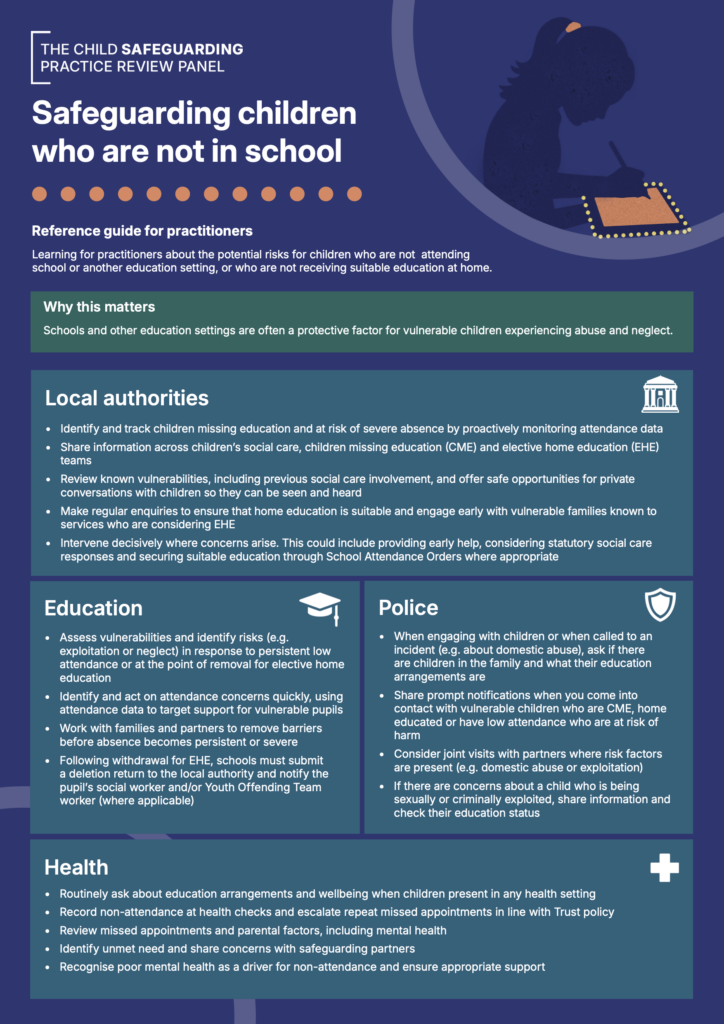
Download and share this quick reference guide with practitioners and teams.
Briefing papers and learning
Briefing papers
Short guides to support team reflection and local learning:
Local resources
Safeguarding Partnerships submitted these locally developed resources to support effective multi-agency working. You may wish to use these resources as a guide to support the development of a similar resource or process in your local area.
Have you developed a resource or tool that could support safeguarding practice elsewhere? Share it with us.
What you need to know in your role
All practitioners, including those in the voluntary and community sector, have a legal duty to safeguard and promote the welfare of children. In line with the Children Act 1989 and Working Together to Safeguard Children, safeguarding is everyone’s responsibility. While we have drawn out key learning for specific agencies, it applies to all practitioners across settings and professions.
- Local authorities’ safeguarding duties apply to home educated children in the same way as they do for children educated at school.
- Ensure join up between elective home education teams and children’s social care so safeguarding concerns can be triangulated.
- Ensure elective home education teams have access to safeguarding training.
- Ensure the child has safe opportunities to speak, including private conversations where needed, and have early engagement with the whole family when parents consider home education.
- Education settings should work with local authorities to identify and support children missing education to receive a suitable education.
- Persistent low attendance is often one of the earliest indicators of neglect. Do not treat persistent low attendance just as an education issue. Assess other vulnerabilities, identify opportunities for safeguarding, and share information with multi-agency partners.
- Identify vulnerabilities at the point of removal from school for elective home education. Where concerns exist develop multi-agency plans for support and intervention.
- Health practitioners and services (e.g. GPs) may sometimes be the only professionals who see a child who is home educated, missing education or has low school attendance.
- When engaging with children (for example, if they present at hospital), ask about education arrangements and school attendance.
- Poor mental health can be a driver for low school attendance. Appropriate mental health support options should be considered for the child or young person concerned.
- Not attending school at all and not receiving a suitable education otherwise than at school can increase a child’s vulnerability to criminal exploitation, sexual exploitation and modern slavery.
- When engaging with children, ask about education arrangements and school attendance.
- Collaborate and share information when a child is removed for home education or known to be missing education.
- Consider joint visits with other agencies where risk factors are known. For example, where there is domestic abuse or exploitation and the child is known to be missing education.
- No single person or agency can fully understand a child’s circumstances on their own. To ensure children receive timely and appropriate support, agencies should work together to identify whether a child is home educated, missing education or has low attendance.
- Information should be actively shared and there should be clear roles and responsibilities allocated amongst practitioners when concerns arise.
- When engaging with children, all practitioners should always ask about education arrangements and school attendance. Evidence shows that it is often this type of interaction that leads to uncovering the bigger picture of the child’s lived experience.
Online learning
Webinar
This webinar, held on 15 July 2026, explored how practitioners can confidently identify and respond to safeguarding concerns about vulnerable children who have low school attendance, are home educated, or missing education.
You can read a summary of the event here.
Further resources