
Adolescent suicide
Suicide is one of the leading causes of death among children in England and the second most common cause of death in serious child safeguarding incidents in recent years. This page brings together learning from reviews, key evidence, and practical resources to help practitioners understand how suicide risk can build over time and recognise escalating vulnerability earlier.
Key information
Adolescent suicide is rarely the result of a single event. Learning from safeguarding reviews highlights how risk develops over time and where practice can make a difference.
-
Risk is cumulative, not sudden. National evidence and safeguarding reviews consistently show that suicide is associated with multiple, interacting experiences, including abuse, neglect, bullying, mental health difficulties, family adversity and social isolation.
-
Most children were already known to services. Although many children in safeguarding reviews were known to children’s social careand involved with several services, involvement from multiple agencies did not always result in a shared understanding of risk or a coordinated response.
-
Earlier concerns often preceded the death. Suicide was frequently preceded by self-harm, overdose or suicidal thoughts. These earlier concerns were not always recognised as indicators of escalating risk, particularly where they had become familiar over time.
-
Distress is not always expressed in expected ways. Children who are neurodivergent, disabled or living with trauma may show distress differently. Receiving support, including being looked after by the local authority, does not mean risk has reduced.
Briefing papers and learning
Briefing paper
The Panel’s Annual Report 2024–25 identifies suicide as the second most common cause of death in serious child safeguarding incidents, most often involving older adolescents.
This briefing paper, Adolescent suicide: The child behind the story – understanding cumulative harm through lived experience, brings together learning from these incidents, and includes a recent sample of rapid reviews relating to 20 deaths by suicide and 2 incidents of serious harm following self-harm.
It is a learning and reflection resource for practitioners and leaders across safeguarding services, exploring how suicide risk can build over time and how cumulative harm can be understood from the child’s perspective. It can be used in supervision, team discussions, learning events or multi-agency forums.
Local reviews
We have selected these local reviews as case studies to highlight useful learning. If you are writing a rapid review or commissioning an LCSPR about adolescent suicide, consider the learning from these published reviews as part of your work.
Local resources
Safeguarding Partnerships submitted these locally developed resources to support effective multi-agency working. You may wish to use these resources as a guide to support the development of a similar resource or process in your local area.
- Sussex Safeguarding Children Partnerships: Response to a Suspected Suicide – this resource outlines the membership, purpose and timeline of a multi-agency group convened after a suspected suicide by a child or young person, including support for those affected
- Havering Council: Suicide Prevention Toolkit – this toolkit was developed with input from a lived experience advisory group, providing information about stigma, risk and protective factors, and practical advice
Have you developed a resource or tool that could support safeguarding practice elsewhere? Share it with us.
Infographics and statistics
The Panel’s Annual Report 2024–25 identified suicide as the second most common likely cause of death in serious child safeguarding incidents over the last three reporting years.
The report includes an analysis of 64 child deaths by suicide notified to the Panel between 1 April 2022 and 31 March 2025, representing 14% of all child deaths notified during that period.*
These findings reinforce that suicide often occurred in the context of multiple vulnerabilities, cumulative harm and ongoing professional involvement, rather than a single event.
*The Panel’s data relates to serious child safeguarding incidents where abuse or neglect is known or suspected and is not representative of all child suicides nationally.
Of children who died by suicide notified to the Panel between 1 April 2022 and 31 March 2025:
Poster
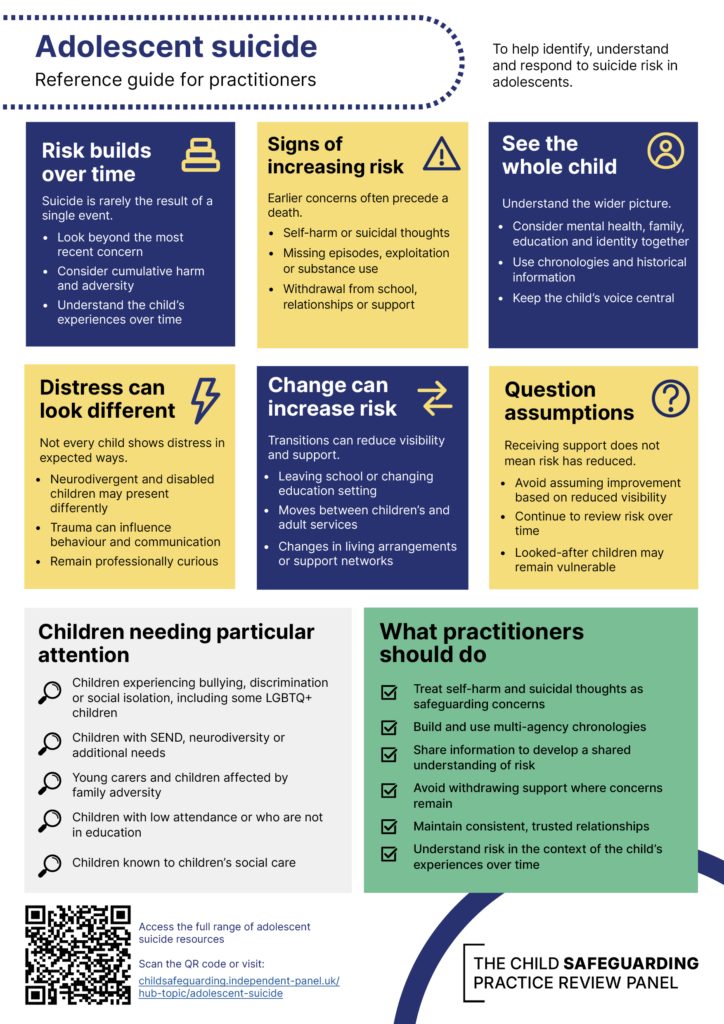
Download and share this quick reference guide with practitioners and teams.
Learning points
Key actions you can take to better understand, assess and respond to suicide risk.
- Understand self-harm and suicidal thoughts as part of a wider picture of escalating vulnerability, not isolated events.
- Use chronologies and historical information to understand how harm and distress have built over time.
- Notice patterns, changes and turning points in a child’s presentation and circumstances.
- Take a holistic view of harm, mental health, family relationships, education, identity and care experience.
- Ensure the child’s voice is not lost within assessments, processes or service thresholds.
- Recognise that distress may be expressed differently, particularly where there is trauma, neurodiversity or disability.
- Share information effectively so that involvement from multiple agencies builds a shared understanding of risk.
- Ensure safety plans and key concerns are shared with all relevant agencies and those with parental responsibility.
- A clearly identified professional should maintain oversight where concerns exist, particularly when a child’s visibility reduces or vulnerability escalates.
- Children receiving support, including those who are looked after, may remain vulnerable and continue to experience harm.
- Avoid premature withdrawal of services where concerns remain.
- Reflect corporate parenting responsibilities in responses to ongoing vulnerability.
- Maintain consistent relationships so children’s changing needs can be understood over time.
- Use supervision to think critically and explore uncertainty, not only to manage cases.
What you need to know in your role
All practitioners, including those in the voluntary and community sector, have a legal duty to safeguard and promote the welfare of children.
In line with the Children Act 1989 and Working Together to Safeguard Children, safeguarding is everyone’s responsibility. While we have drawn out key learning for specific agencies, it applies to all practitioners across settings and professions.
- Build a cumulative picture of harm using chronologies and historical information, including previous referrals, earlier self-harm and prior service involvement.
- Do not close cases based on superficial improvement; ensure progress is sustained and meaningful for the child before withdrawing support.
- Recognise that entry into care can itself be a source of trauma. Looked-after children may remain highly vulnerable, and corporate parenting responsibilities should shape the response to ongoing risk.
- Ensure information is shared with, and sought from, everyone with parental responsibility, and check assumptions rather than relying on one parent’s account.
- Coordinate multi-agency responses so that safety plans and information about vulnerability are shared across services.
- You may be the professionals who see a child most often. Changes in attendance, behaviour, friendships and engagement can be early indicators of escalating distress.
- Bullying, discrimination and exclusion, including those linked to identity or sexual orientation, featured in reviews as sources of isolation and vulnerability. Consider reports carefully and consider their cumulative impact.
- Where a child is withdrawn from school, including for elective home education, they may lose access to trusted adults, friendships and school-based support at exactly the point vulnerability is increasing. Always share safeguarding information before the child leaves your roll.
- Consider whether school non-attendance or distress may reflect unmet needs, including possible neurodivergence, and ensure assessments are progressed rather than left open.
- Create safe opportunities for children to talk, and record and share concerns so they contribute to the wider picture.
- Self-harm, overdose and suicidal thoughts may indicate escalating vulnerability and should be considered alongside the child’s wider experiences. Respond to each presentation with curiosity, urgency and depth, even where these have become familiar over time.
- Ensure safety plans developed in health settings, including emotional wellbeing and CAMHS services, are shared with other agencies and with those with parental responsibility.
- Recognise that distress may present differently in children who are neurodivergent, disabled or affected by trauma, and that mental health needs often co-exist with other adversities.
- Pay particular attention to transitions, including between services, into care, and towards adult services, when contact and continuity can be lost.
- Where a parent has significant mental or physical health needs, consider the impact on the child, including caring responsibilities, and ensure adult and children’s services communicate.
- Missing episodes, exploitation and substance use featured in reviews as indicators of escalating vulnerability. Ensure this information reaches children’s social care and partner agencies quickly.
- When responding to incidents of self-harm or attempted suicide, treat these as safeguarding concerns requiring multi-agency follow-up, not only as immediate medical matters.
- Officers may hold information about exploitation, missing episodes or adults posing a risk that other agencies do not. Record and share these observations promptly.
- Contribute to multi-agency risk assessment for adolescents, recognising that harm outside the home interacts with vulnerability at home.
- All those who work with children, including in the voluntary and community sector, can hold important pieces of the picture. If you have a concern, share it.
- Focus on patterns and the child’s experiences rather than viewing incidents in isolation.
- Trusted relationships matter. Youth workers, sports coaches and community organisations may be among the few consistent adults in a child’s life.
- Do not assume that because a child is receiving support from statutory services, they are less vulnerable or no longer at risk.
Online learning
Slide pack
Download and adapt these slides to support local reflection, discussion and learning.
We encourage local safeguarding children partnerships and team leaders who work with children in different multi-agency settings to edit this resource for local use.
Further resources
Find more information and practical tools from other organisations.
- NICE guideline NG225: Self-harm – assessment, management and preventing recurrence
- NHS England: Staying safe from suicide – best practice guidance
- NHS England / MindEd: Self-harm and suicide prevention learning and resources
- Office for Health Improvement and Disparities: Suicide prevention guidance and resources