
Online harms
As children’s lives become increasingly digital and subject to online influences, safeguarding practice must keep pace. Learning from serious incidents reviewed by the Panel shows that online activity can intensify existing vulnerabilities and may not always be recognised or understood early enough. These resources help practitioners recognise and respond to online harm earlier and make children’s online lives part of routine safeguarding practice.
Key information
Safeguarding reviews provide growing evidence that online harm features in serious incidents involving children and young people. The following themes can help practitioners recognise online harm earlier and respond to it more effectively.
-
Online harm is often missed
Opportunities to identify harm may be missed when children’s online lives are not routinely explored. -
Serious harm can occur in unseen digital spaces
Online relationships, harmful content and exploitation may not be immediately visible to parents, carers or practitioners. This can include harmful content or interactions associated with emotional distress, self-harm or suicide risk. -
Online activity is rarely the sole driver of harm
It most often acts to facilitate, accelerate or intensify existing vulnerabilities, shaping how harm develops and escalates. -
Online relationships are real relationships
They can be emotionally significant. Trust and regular communication can develop into grooming, manipulation, increasing demands, pressure or control. -
Online harm can occur within and outside the family
Online harm is real-world harm. It may occur entirely online, coexist with abuse within or outside the family, or progress to contact and abuse offline. -
Routine enquiry strengthens safeguarding practice
Practitioners should explore children’s online activity and relationships as part of routine safeguarding enquiry and assessment, rather than waiting for disclosure of online harm. Relevant information should be shared across agencies to build a fuller picture of risk.
Briefing papers and learning
Briefing papers
The Panel has developed a series of briefing papers to help practitioners and leaders understand how online environments can feature within children’s experiences of serious harm. The papers explore different aspects of online harm, with learning that may overlap across safeguarding contexts. They support routine enquiry, earlier recognition and coordinated responses, and can be used in supervision, team discussions and multi-agency learning.
Explores overarching learning about online harms as a cross-cutting safeguarding issue, supporting earlier recognition and routine exploration of children’s online lives.
Explores how online activity can feature in child sexual abuse and exploitation, including grooming, coercion and connected patterns of harm.
Explores how online activity can interact with emotional wellbeing, self-harm and suicide risk, including harmful content and online relationships.
Local reviews
If you are writing a rapid review or commissioning an LCSPR involving online harm, consider relevant learning from published reviews and case studies as part of your work.
Infographics and statistics
Figures are drawn from analysis of all rapid reviews received by the Panel between 1 April 2024 and 31 March 2025, alongside more detailed analysis of reviews where online harms were specifically identified.
These figures are likely to under-represent the scale of online harm because online activity is not always identified, explored or recorded in safeguarding systems or in the reviews following serious incidents.
Online harms are linked to wider safeguarding concerns
Online harms featured in reviews involving child sexual abuse, exploitation, neglect and suicide.
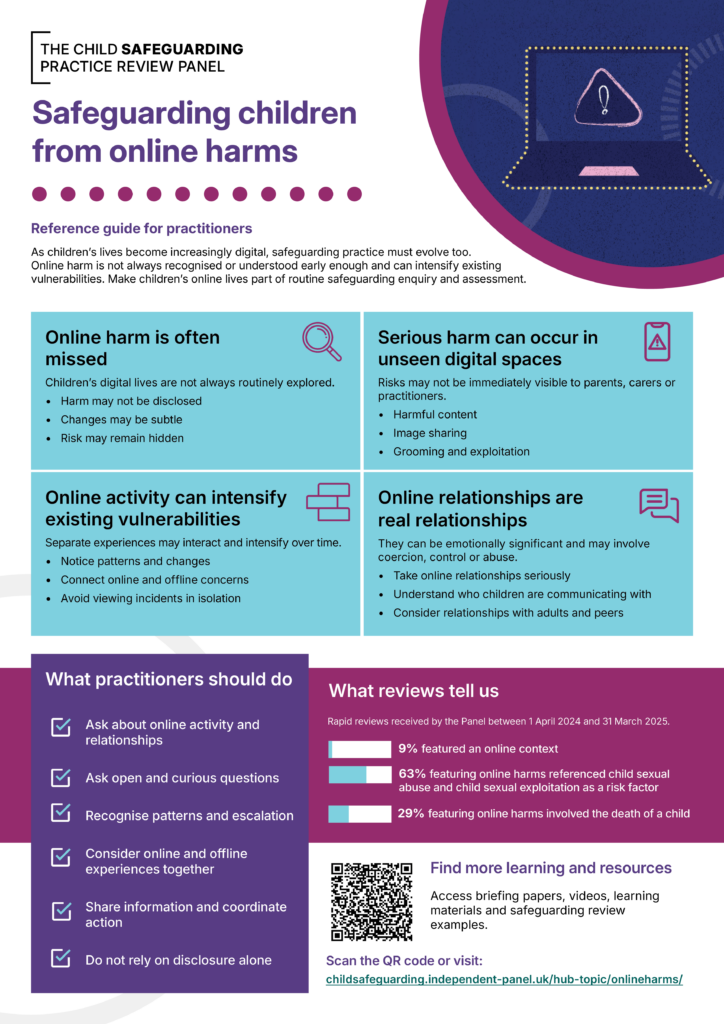
Poster
Download and share our one-page online harms reference guide with your teams.
Learning points
- Ask about online activity, relationships, platforms, accounts and changes in online behaviour
- Do not rely solely on disclosure
- Revisit online activity when concerns persist or circumstances change.
- Ask specific, curious and non-judgemental questions rather than relying only on general questions about online safety
- Explore how the relationship began, how it has changed and what the child understands about the other person
- Consider whether trust or emotional dependency is being used to make demands or exert control
- Explore pressure, threats, blackmail or demands relating to images, money or other online activity
- Recognise that harm may remain online, coexist with abuse within or outside the family, or progress to contact and abuse offline
- Consider repeated incidents and changes over time
- Connect online activity with missing episodes, emotional distress and wider safeguarding concerns
- Avoid treating image sharing, harassment or online contact as isolated events
- Bring together information held by different agencies, family members and carers to identify patterns of risk
Online abuse and exploitation can develop through relationships and communication over time. It may involve increasing demands, pressure, threats or blackmail; images, messages or personal information being used to control a child; demands for money; AI-created or altered images; or someone misrepresenting their identity. In some cases, online contact may progress to contact and abuse offline.
Practitioners should:
- explore what terms such as grooming, coercion and exploitation mean for the child’s actual experience
- ask whether the child is experiencing pressure, threats, blackmail, control or demands
- consider whether sexualised communication or image sharing may indicate exploitation rather than viewing incidents in isolation
- preserve relevant digital evidence and share information promptly
- agree coordinated action to protect the child and disrupt the harm
- Explore whether harmful online content, including content encouraging suicide, interactions or relationships may be contributing to emotional distress, self-harm or suicide risk
- Consider whether online influences are interacting with existing vulnerabilities
- Include online activity in holistic assessment, safety planning and safeguarding responses
- Recognise that risk may be hidden or change rapidly, including where a child appears settled or future-focused
- Use ongoing and adaptable safety planning, recognising that restricting one route of internet access may not remove other routes
- Consider online and offline experiences together
- Consider trauma, emotional wellbeing, neglect, previous harm and changes in behaviour or relationships as part of the wider safeguarding picture
- Recognise that a settled or positive presentation does not necessarily mean risk has reduced
- Share information and build a joined-up understanding of risk across agencies
- Include online concerns in assessments, safety plans and safeguarding responses
- Act on emerging indicators rather than waiting for harm to escalate
- Agree coordinated action to protect the child and disrupt harm
- Keep safeguards under review as circumstances, relationships and routes of online access change
The learning above can inform conversations with children about their online lives. Use open and non-judgemental questions, adapting them to the child and their circumstances.
Starting the conversation
- What do you enjoy doing online?
- Who do you spend time talking to online?
- Has anything changed recently in what you do or who you talk to online?
- Is anything happening online that you are worried about or would like help with?
Where there are signs of pressure or exploitation
- How did the relationship begin and how has it changed?
- Has anyone pressured, threatened or frightened you online?
- Has anyone used an image, message or personal information to control you?
- Has anyone asked for money, images or something else you did not want to provide?
- What would help you feel safer now?
What you need to know in your role
All practitioners, including those in the voluntary and community sector, have a legal duty to safeguard and promote the welfare of children. In line with Working Together to Safeguard Children, safeguarding is everyone’s responsibility. While the learning below highlights actions for specific agencies, routine enquiry, early recognition and active exploration of children’s online lives apply across all roles.
- Understand children’s online and offline experiences together
- Explore online relationships, image sharing, hidden accounts, multiple devices and changes in online behaviour as part of assessment
- Consider how trauma, emotional needs, neglect and earlier experiences may increase vulnerability online
- Actively explore concerns rather than relying solely on what a child tells you, reassurance or parental oversight where concerns persist
- Include cumulative and contextual online risk in safeguarding assessments, plans and multi-agency responses
- Recognise that changes in attendance, behaviour, friendships or engagement may indicate online harm
- Create safe opportunities for children to discuss online relationships, harmful content, bullying and harassment
- Consider whether information from peers, including rumours or concerns about online relationships, may indicate potential harm
- Explore changes in use of platforms, accounts or online behaviour when concerns arise
- Record and share concerns so they inform safeguarding assessment and coordinated action
- Include online activity in assessments of emotional wellbeing, self-harm and suicide risk
- Explore whether harmful content, online relationships, harassment, coercion or image sharing may be contributing to distress
- Recognise that risk may be hidden or rapidly escalating, including when a child appears settled or future-focused
- Consider online experiences alongside emotional wellbeing, trauma and other vulnerabilities to build a fuller picture of risk
- Share relevant information with safeguarding partners so that online concerns inform a coordinated assessment and response
- Recognise online contact, sexualised communication, image sharing and missing episodes as potential indicators of exploitation
- Respond promptly to image-based abuse and consider the preservation and examination of relevant digital evidence
- Consider device examination, digital forensics and opportunities to identify and disrupt those causing harm
- Explore links between online contact, missing episodes and relationships with adults or peers
- Share intelligence and safeguarding concerns promptly to support coordinated multi-agency action
Practitioners in youth services, youth justice, voluntary and community organisations and other services working with children should:
- be alert to changes in behaviour, relationships or online activity that may indicate emerging harm
- create safe opportunities for children to talk about their online experiences without blame or judgement
- take concerns from children, families and peers seriously, even where information is informal or incomplete
- share relevant safeguarding concerns with partner agencies so they contribute to the wider picture of risk
- continue to act where concerns persist, including when a child disengages, minimises concerns or does not tell practitioners about harm.
Online learning
Slide pack
Download and adapt these slides to support local reflection, discussion and learning.
We encourage local safeguarding children partnerships and team leaders to use this resource during team discussions, supervision and learning events.
Further resources
Find more information and practical tools from other organisations.
- NSPCC Learning: online safety guidance and resources
- UK Safer Internet Centre
- NCA–CEOP guidance, policy and research for professionals
- CSA Centre: key messages from research on child sexual abuse by adults in online contexts
- Youth Justice Resource Hub: online harms affecting children evidence pack
- Children’s Commissioner: What I wish my parents and carers knew… (pages 20–21 on children’s preferred platforms and AI tools)